AI Trading Engine Review 2026: Legit Research Tool or Hype?

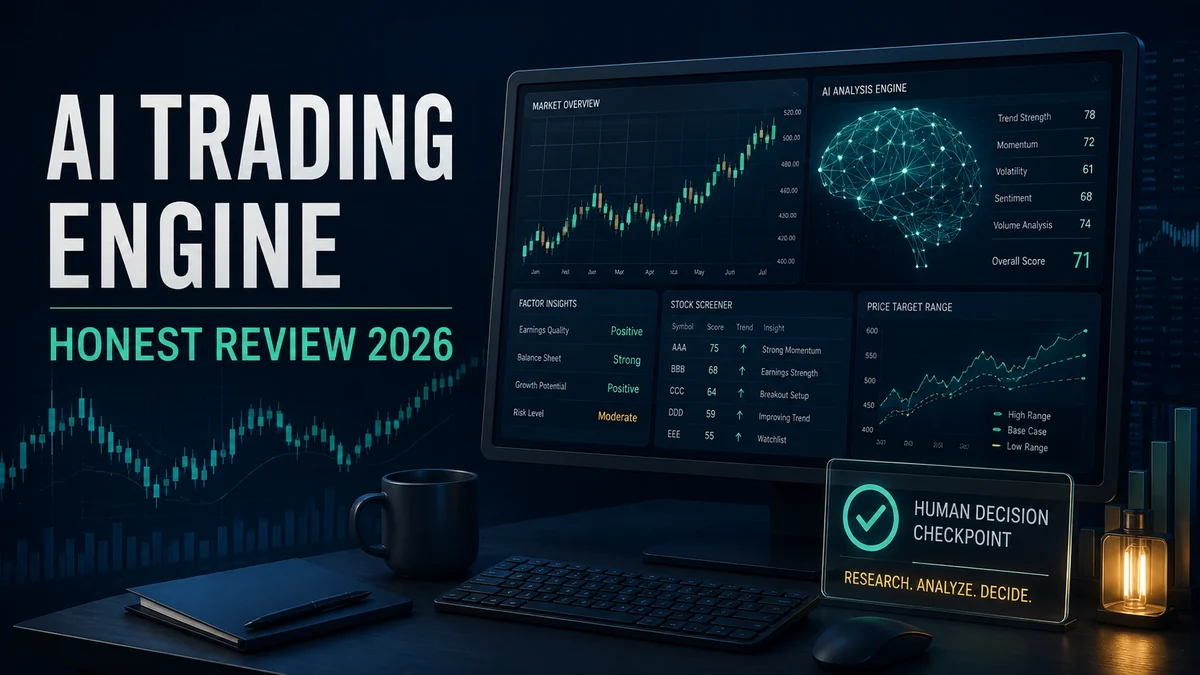
A useful research workflow, not an automatic trading bot
AI Trading Engine is an AI-assisted stock-research system taught through a five-day live masterclass—not software that connects to your broker and trades for you. Its central component, a local AI agent called Wayland, is presented as a way to screen a defined stock universe, test ideas against historical data, and produce a morning brief. You review the reasoning and decide whether to act.
My short verdict: the $47 masterclass was a reasonable entry point for traders who wanted a guided setup and were prepared to validate everything in paper trading. It was a poor fit for anyone seeking passive income, audited performance, or a hands-off bot. There is another practical catch today: the affiliate link now lands on an official closed-cart page stating that enrollment closed Monday, September 7, 2026. This review therefore explains the offer for research purposes and for any future reopening; it does not manufacture urgency around a checkout that is no longer available.
AI Trading Engine Review at a Glance
| Product type | AI-assisted market research workflow plus live implementation training |
| Core tool | Wayland, described as a local agent running on the user’s computer |
| What it does | Screens stocks, analyzes charts, backtests ideas, and prepares a research brief |
| What it does not do | Place trades, connect to a brokerage account, or guarantee profitable outcomes |
| September 2026 price | $47 for the five-day masterclass; $497 for the advertised complete bundle |
| Current availability | Closed as of September 7, 2026; the supplied link redirects to the official closed page |
| Overall verdict | Worth considering only when open, for disciplined users who will paper-test first |
What Is AI Trading Engine?
AI Trading Engine is a commercial trading-education and software-setup offer created by Sean Donahoe and sold through ADD Marketing Group, LLC on JVZoo. The September 2026 entry offer centered on a five-day live masterclass. Students were shown how to install and configure the Wayland agent, review its research, practice execution with TradingView paper trading, build a journal, and refine a repeatable process.
The name can sound more autonomous than the product actually is. Based on the public materials, this is best understood as a decision-support system. It attempts to compress the repetitive part of market research into a structured report, while leaving judgment and order execution with you. That human checkpoint is a strength, not a missing feature: handing real money to a new black-box bot would be a much worse proposition.
How the AI Trading Engine Works
The advertised workflow starts locally on your computer. You establish the strategy rules and watchlist, then Wayland performs research and historical testing. The output is a concise brief intended to explain what qualified, why it qualified, and the potential entry and exit framework. You then inspect the evidence rather than treating the output as an instruction.
The five class days were organized around setup, finding candidates, practicing execution, expanding the journal/review loop, and a final question-and-answer session. Replays, transcripts, written action plans, a private community, and an additional seat for a spouse or partner were listed in the launch package. Because the live cohort has already begun, future buyers should confirm whether a reopening includes live coaching, recordings, or a different delivery format.
Key Features—and Their Limits
Overnight stock research and morning briefs
The main convenience is starting the day with a filtered research brief rather than an empty chart. This could save time and promote consistency. It does not remove the need to check current news, liquidity, spreads, earnings dates, data quality, or whether the market regime has changed.
Historical testing
Backtesting can expose obviously weak rules and show how a setup behaved across past data. It can also create false confidence through overfitting, survivorship bias, ignored transaction costs, and favorable parameter selection. The vendor has promoted strong win-rate and trade-count claims, but we did not find an independent audit with a complete methodology, drawdown profile, benchmark, or live track record. Treat those figures as vendor claims, not verified performance.
Paper-trading practice
Using a TradingView practice environment during training is sensible because mistakes remain cheap. Paper results still differ from live trading: fills are cleaner, emotions are muted, and slippage may not be realistic. A profitable simulation is permission to test further—not permission to size up aggressively.
Local control with no advertised engine subscription
Launch materials describe the engine as running on the user’s own computer and say the engine itself has no monthly fee. That may appeal to buyers avoiding another SaaS subscription, but local software shifts setup, uptime, updates, and troubleshooting onto the user. Data, charting, AI-model, newsletter, or brokerage-related services could still have separate costs; verify the current requirements before buying.
Who Is It For?
- Beginners who want a guided, paper-first introduction to a rules-based research workflow.
- Self-directed stock traders who spend too much time screening charts manually.
- Users comfortable installing a local agent and troubleshooting software.
- People willing to inspect the reasoning, journal decisions, and reject weak signals.
- Existing traders who want a research assistant, not an autonomous brokerage bot.
Who Should Avoid It?
- You expect guaranteed income or a system that trades while you sleep.
- You need independently audited live performance before considering a strategy.
- You do not have time to attend training, configure software, paper-test, and maintain a journal.
- You are uncomfortable with financial risk or may trade money needed for living expenses.
- You already use a mature scanner, backtesting platform, and documented trading plan that covers the same workflow.
- You are considering the $497 bundle before proving the $47 core process adds value.
AI Trading Engine Pros and Cons
- Human approval remains central to every decision.
- Combines screening, research, testing, and reporting into one routine.
- Paper-trading instruction reduces the pressure to risk capital immediately.
- The $47 entry offer was far less costly than the complete bundle.
- The engine was advertised without a monthly engine fee.
- No independently audited performance record was found.
- Backtests can mislead when assumptions and costs are incomplete.
- Local setup may be technical for some beginners.
- The upsell ladder can raise the real purchase substantially.
- The live launch has closed, limiting current usefulness of the affiliate link.
- Education and tooling cannot remove market risk.
Pricing, Bundle, and Optional Upgrades
JVZoo’s product listing confirms the following September 2026 offers. These are launch prices, not a promise of future terms:
| Offer | Advertised price | What it appears to add | Required? |
|---|---|---|---|
| 5-Day Live Masterclass | $47 | Core engine setup, live training, action plans, coaching, community, transcripts, notes, Q&A and replays | Core offer |
| Inside Edge | $29/month after an advertised 14-day trial | Ongoing newsletter/membership | No |
| Red Carpet Access | $97 | Extended access and additional training, including a crypto-oriented track in public descriptions | No |
| Inner Circle | $197 | Broader screening universe and strategy-library material in public descriptions | No |
| Profit Protocol Intensive | $497 | Advanced one-day workshop around the advertised SPX framework | No |
| Mega Bundle | $497, or 3 payments of $197 | Complete launch package, including higher-tier training | No |
The installment route totals $591, which is $94 more than paying $497 upfront. More importantly, the upgrade path only makes sense after the core workflow proves useful in your own paper testing. Starting with every add-on is a $497 vote of confidence before you have evidence. The quieter $47 experiment was the better buying decision for most newcomers.
Check Whether Enrollment Has Reopened
Is AI Trading Engine Legit or a Scam?
AI Trading Engine appears to be a real product and training program with a named creator, a concrete setup workflow, a live class schedule, and recorded JVZoo transactions. JVZoo identifies Sean Donahoe as the seller and shows sales across the offer ladder. Those facts support product existence; they do not validate profitability.
The largest evidence gap is performance. Public promotions cite large historical tests and high win-rate figures, but those numbers are self-reported and incomplete without the rules, data treatment, fees, drawdowns, rejected trades, risk per trade, and an independent audit. A legitimate research tool can still lose money. My assessment is therefore legitimate offer, unverified trading edge.
Alternatives to Consider
- TradingView plus a written checklist: cheaper and simpler if you mainly need charts, alerts, and paper trading, but it requires more manual screening.
- A dedicated backtesting platform: stronger for transparent strategy research and metrics, although usually less conversational and potentially more technical.
- A reputable trading course with audited examples: better when your main gap is risk management and market structure rather than automation.
- Your existing AI assistant plus spreadsheets: flexible for summarizing research and journaling, but financial data must be sourced carefully and hallucinations remain a risk.
Final Verdict: Is AI Trading Engine Worth It?
The strongest part of AI Trading Engine is its human-in-the-loop workflow: let software do repetitive research, then require the trader to inspect, paper-test, and decide. The biggest weakness is the lack of independently verified performance evidence behind the promotional numbers.
If the offer reopens at $47 with the same live training and no required subscription, it can be a modest educational experiment for someone who understands the risks. Skip the $497 bundle until the core workflow has demonstrably improved your research process. Skip the product entirely if what you really want is passive, automatic profit.
Visit the Official AI Trading Engine Page
Frequently Asked Questions
Does AI Trading Engine automatically place trades?
No. Public product material states that it does not connect to your broker or execute trades. The user makes the final decision.
How much did AI Trading Engine cost?
The September 2026 five-day masterclass was listed at $47. A complete bundle was advertised at $497 or three payments of $197. Future pricing may differ.
Is there a monthly fee?
The engine itself was advertised without a monthly engine fee. The optional Inside Edge offer was listed at $29 per month after a trial, and external services may have separate costs.
Can beginners use it?
The guided setup and paper-trading format were designed to be approachable, but beginners still need to learn risk management and may face technical setup work.
Is enrollment open now?
No. On September 8, 2026, the supplied affiliate link redirected to an official page saying enrollment closed Monday, September 7 and the masterclass is now running.